Sometimes, life brings unwelcome news — a setback, a loss, an illness — that causes us to look inward. And sometimes, in looking inward, we in turn look outward, channeling a personal challenge into a need to help others.
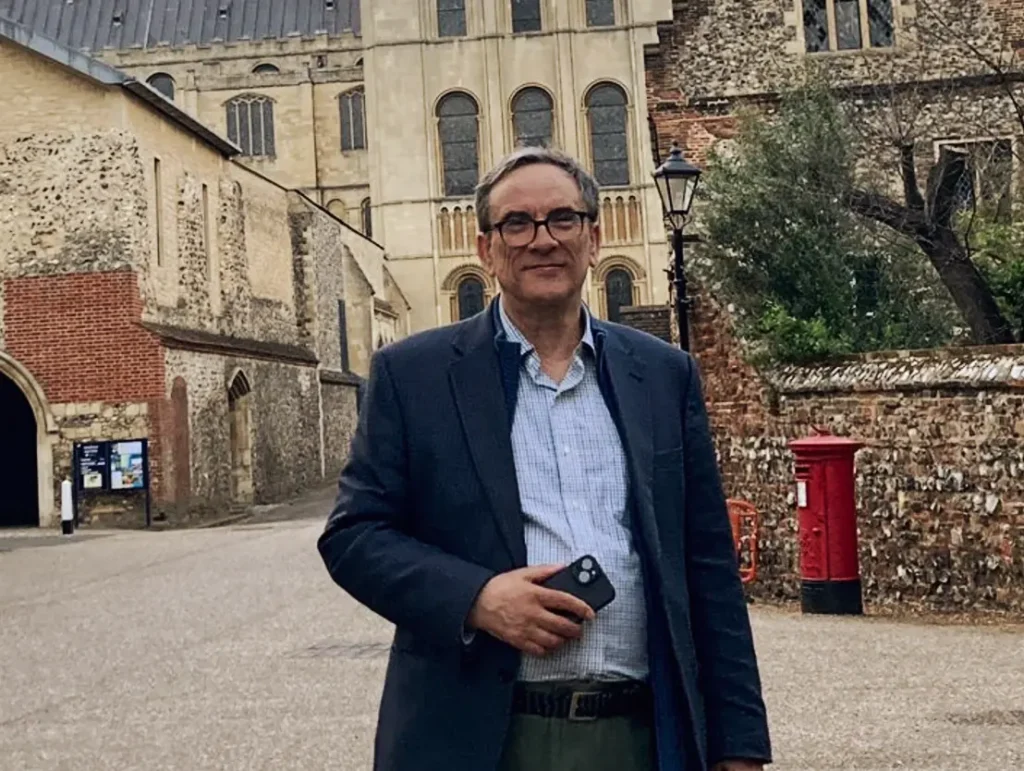
So it has been for Nick Richardson, a 69-year-old father of two, who came to the US from England in 1990 and now lives in Westchester County, NY. Nick is a former longtime Communications Director with the Episcopal Diocese of New York, and a dear friend and ally of Rural & Migrant Ministry. His struggle with liver failure has inspired him to spread the message of living donor organ transplantation far beyond his own inner circle.
Nick has launched a website (http://nickliverdonor.com) — he builds and optimizes websites professionally — and a Facebook page that not only chronicle his own need for a transplant, but explain the benefits and requirements for all donors and recipients.
“One of the things that doing that did was make it real,” Nick said of his personal journey.
“When I told an old friend about my condition last night, his immediate reaction was to wonder why anyone would sacrifice their life so that I could live!” reads one of his Facebook posts. “He had never heard of a living (emphasis on living, please!) donor liver transplant, and didn’t know that the liver is the one organ in the body that regenerates itself. No people are harmed in the performance of this miracle!”
Though he’d been diagnosed with liver disease 12 years ago, he was completely asymptomatic until last year, when he began to experience intermittent cognitive debilitation as the result of the onset of a condition called hepatic encephalopathy. This causes Nick to suffer from severe brain fog, broken sleep patterns, and debilitating exhaustion.
He is managing to some degree with the help of medications, including “a highly targeted, nose-bleedingly expensive antibiotic.” But, he knows, “It could become urgent at any time.”
However, there are few institutional resources connecting living donors with recipients, so it all comes down to finding someone within his extended network. Because he formerly worked for the Episcopal Diocese of New York and because his partner of 14 years, Elizabeth, is also well-connected in charitable circles, Nick has every reason to hope he will find a donor. But others face far worse odds.
“There are large numbers of people out there who need a living donor liver who struggle to get the word out, or can’t bring themselves to ask, or are simply too exhausted,” he said.
Nick is therefore spreading awareness about what it means, and what it takes, to become a living donor — not just for his own wellbeing, but for the sake of the nearly 10,000 people currently in need of the procedure.
Although there are restrictions such as age limits for donors and blood-type compatibility between specific donors and patients, “There are many ways of doing it,” Nick said. “We should not try to pre-qualify people. And if someone is willing to donate to someone they know or to whom they have a connection, they might, with a little bit more thought, be willing to donate to anybody who needs it. And so, I don’t want to stop anybody coming forward who might not be a match for me, but might be a match for someone else out there.”
His website offers answers to many of the questions prospective donors ask, as well as links to a donor application and video from New York Presbyterian Hospital/Columbia University/Weill Cornell Medicine, where Nick will undergo his transplant.
“And then I look forward to coming out the other end, when I am restored to fitness.” he said. “Once I’ve had the operation, there are challenges after that, but they’re not mental, and I will be able to function fully.”
He looks forward to the activities he loves best: visiting his native England, playing with his beloved dog, Riley, spending quality time with his family and friends, keeping his keen, curious mind sharp by reading Homer in the original Greek, and fly-fishing in the pristine waters of the Sullivan County Catskills and beyond.
“Being in the midst of nature, it excludes everything else,” Nick said. And that is really the point: to be present in every moment, to experience the world fully — to live.
“Nick has shown tremendous courage,” said the Rt. Rev. Matthew Heyd, Bishop of New York. “I hope that we can support him in this journey as he prepares for a transplant.”
“Nick Richardson has walked the journey with so many of us in the Diocese, helping to ensure that our voices are heard,” added the Rev. Richard Witt, Executive Director of Rural & Migrant Ministry. “Now is the opportunity for us to walk the journey with Nick through our prayers and our actions. I hope that we will all take this opportunity to get the word out and help Nick find a donor.”
To learn more about becoming a living donor for Nick or someone else in need of a liver transplant, click here.