By Roark Petermann
Jennifer Beckham’s question wasn’t working.
In a leadership session with members of Rural & Migrant Ministry’s Youth Arts Group (YAG), she asked participants to write about what mattered most to them. The room stayed silent.
So, she tried a different question.
“What keeps you up at night?”
After a long pause, the answers came: mental health, poverty, homophobia.
“People have a hard time waiting,” says Beckham, a Master of Divinity student at Virginia Theological Seminary. “But sometimes you have to be okay with silence at first.”
This willingness to sit with uncomfortable questions, and trust that honest answers will come, captures the spirit of RMM’s 2026 Seminarian Fellowship cohort.
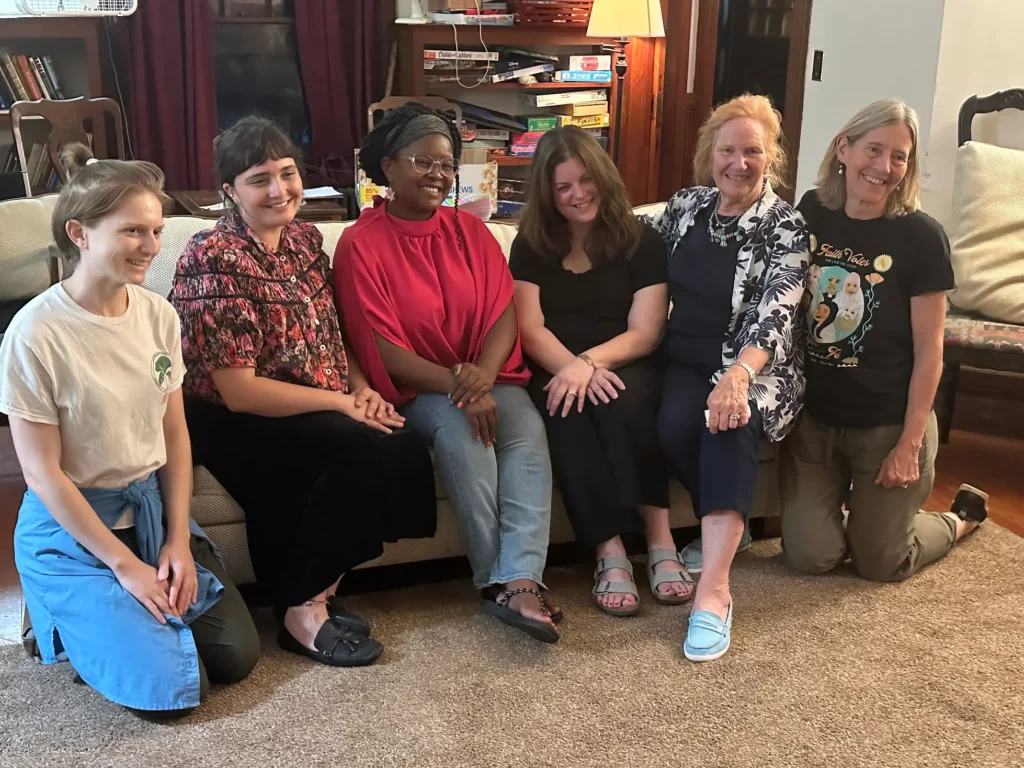
Over ten weeks, five seminarian fellows lived together in community at RMM’s Hudson Valley campus, balancing grassroots organizing, congregational placements, and theological reflection. This year’s cohort, made up entirely of women, discovered that ministry often begins not with having the right answers, but with learning how to listen.
At the heart of the fellowship is working with youth. Fellows devote roughly 20 hours each week to youth leadership groups and summer programs, which are grounded in principles of popular education and empowerment through the arts.
Rather than assuming experts know what communities need, popular education starts with the experiences and knowledge of the people most affected by injustice. This means the fellows spent weeks building relationships during programming, learning to follow priorities identified by young people themselves.
For Gloria Mathias, a Master of Divinity student at Duke University, that deliberate approach required a shift in perspective.
“Coming from a university context,” she says, “I became good at navigating spaces where hierarchies are very much set in place.”
What initially felt inefficient, however, ultimately reshaped her understanding of how an organization can operate. As she prepares for a career in the nonprofit sector, Mathias says the model of popular education will remain central to her work.
For Memory Holloway, an educator and former arts journalist from Bedford, MA, who is preparing for ordination as a vocational deacon of the Episcopal Church, the experience offered a glimpse of the ministry she hopes to practice.
“Deacons go out of the church and bring the margins back to the forefront,” she explains.
Another 10 hours each week is spent in congregational placements throughout New York’s Hudson Valley. Fellows shadow pastors, preach sermons, and experience the daily rhythms of parish ministry.
At Christ Lutheran Church in Newburgh, Pastor Mary Lou Baumgartner worked alongside Beckham to imagine new programming for students from the nearby high school, many of whom participate in YAG.
“I’m hopeful that we will be able to figure out how to open space for them,” Baumgartner says. “We know that all adolescents struggle, but we know that these kids have particular burdens and deserve all the support that we can gather for them.”
Although the fellowship lasts only one summer, the relationships fellows build often extend far beyond it.
Holloway, who helped operate the Summer Day Program at the Spark Center in South Fallsburg, says the bonds she created with youth have the potential for a ripple effect.
“You only need one person to guide you, and then a bunch of people to help you,” she explains.
Holloway watched the talents and aspirations of Summer Day Program participants blossom, and she hopes to write letters to some to continue guiding them.
Nonhlanhla Shezi, who recently completed her Master of Divinity at Virginia Theological Seminary, found belonging far beyond her congregational placement at Cornwall Presbyterian Church. She joined Rock Voices Hudson Valley, an adult choir dedicated entirely to rock music.
“The community is radically welcoming,” she says. “I’ve built friendships here that will make me stay in touch or eventually come back. In the world of social media and virtual meeting spaces, I believe I will have a forever connection to this place.”
Already ordained as a deacon in South Africa, Shezi sees the fellowship as a continuation of work that has always centered relationships.
After careers in social work, communications, and public relations, she realized that every role prepared her for ministry.
“With all of these jobs, my work centered around community and people. I worked with schoolchildren and, at some point, became like a mother to them. I was also like a faith leader to them.”
Her story reflects a common thread between the women of this year’s cohort.
Few followed a straight path to seminary. They arrived after careers in government, education, journalism, communications, and nonprofit work, discovering only gradually that the parts of their work they found most meaningful were, in many ways, already pastoral.
Beckham experienced that realization while working at the U.S. Department of State.
“I was a staff assistant to an upper-level State Department person, and it seemed like I was providing spiritual care—or pastoral care—in addition to my job,” she recalls. “That’s the part of the job that brought me a lot of fulfillment.”
When her husband suggested they drive past the seminary in D.C., she fell in love with the campus. Soon afterward, she decided to enroll.
Together, the five fellows represent three continents, a 50-year range of lived experiences, and a wide variety of faith traditions. Those differences, rooted in a shared purpose, have become one of the fellowship’s greatest strengths.
Inside and around the Cottage, where fellows live together on the Grail campus in the Hudson Valley, discussion can be just as fruitful as their community and congregational work.
During one commute to the Spark Center, where one of RMM’s Summer Day Program is held, their conversations stretched from the metaphysical questions of climate change, the gendered controversies of “In Persona Christi,” and the resurgence of the trad-wife.
Marcella Gallo, who studies Buddhism and Interreligious Engagement at Union Theological Seminary, says living and conversing with women from different traditions has deepened her own spiritual life.
After growing up in the Christian Science tradition, she has intentionally sought spaces where religious traditions meet, challenge, and enrich one another.
“I think there can be an intensity within the Christian church and community that I appreciate,” Gallo says. “It feels very different from some of the more contemplative spaces that I’ve been in recently.”
These vast, searching conversations populate the 10 hours a week spent with the Rev. Jane Gould, theologian-in-residence. Gould, who coordinates the seminarian program, holds space for fellows to confront the crises of the communities they respond to, as well as the internal crises that accompany the intensity of their work.
“How are we individually and collectively going to become more than what this situation is squishing us down into?” she asks.
As someone who has long occupied and guided women through important positions in religious institutions, Gould sees this year’s all-female cohort as significant—though it came by surprise.
“This is my third year coordinating the program. My first two years, it was majority male. This year we had a couple of men who, for one reason or another, did not make sense to us. And then, all of a sudden, we ended up with five women!”
For Mathias, one of the youngest fellows, that reality carries particular meaning.
“Those who are older than me have witnessed women break down those barriers to be able to occupy positions of leadership,” she says. “But, the way that it feels to me is that my generation sees it as kind of a given. That’s probably a privilege of being young—and that also being all that I’ve seen and known.”
As summer comes to a close, the fellows will scatter across the country. Shezi will begin leading a congregation in Stockton, CA. Holloway will return to teaching at the University of Massachusetts, Dartmouth. Others will continue their theological studies in New York, Virginia, and North Carolina.
They all, however, take with them renewed confidence in the processes of their life-work. The fellowship has taught them that transformation rarely begins with certainty. More often, it comes with trusting in the communities that rise up around them.
“Sometimes you just have to climb that mountain,” Beckham says, returning to the lesson she learned in that quiet room with YAG.
But courage, she has discovered, is not always about making difficult decisions. It is not always a solitary journey, either.
Sometimes, Beckham says, “courage is just holding the door open for someone and saying, ‘Welcome in.’”
Roark Petermann served as a Communications Intern for the summer of 2026.