By Roark Petermann
For years, Rural & Migrant Ministry’s Spark Rural Worker Education Center searched for a place to call home in the Sullivan County Catskills.
After frozen pipes, flooding, and rising rents caused multiple relocations, the Center’s permanent home is now filled with something beyond the programs it hosts: possibility. The Spark Center is a reminder for the young people it serves that where they begin doesn’t have to define where they can go.
Under the leadership of Angela D’Aiuto, Catskills Regional Coordinator and Youth Coordinator, the Center is a hub for vital resources and programs, including its Summer Day Program and the Youth Economic Group. Located at the former St. Andrew’s Episcopal Church in South Fallsburg, the Spark Center is working to build deep relationships while serving young people in one of New York State’s most marginalized counties.
Living into that mission makes for a busy time.
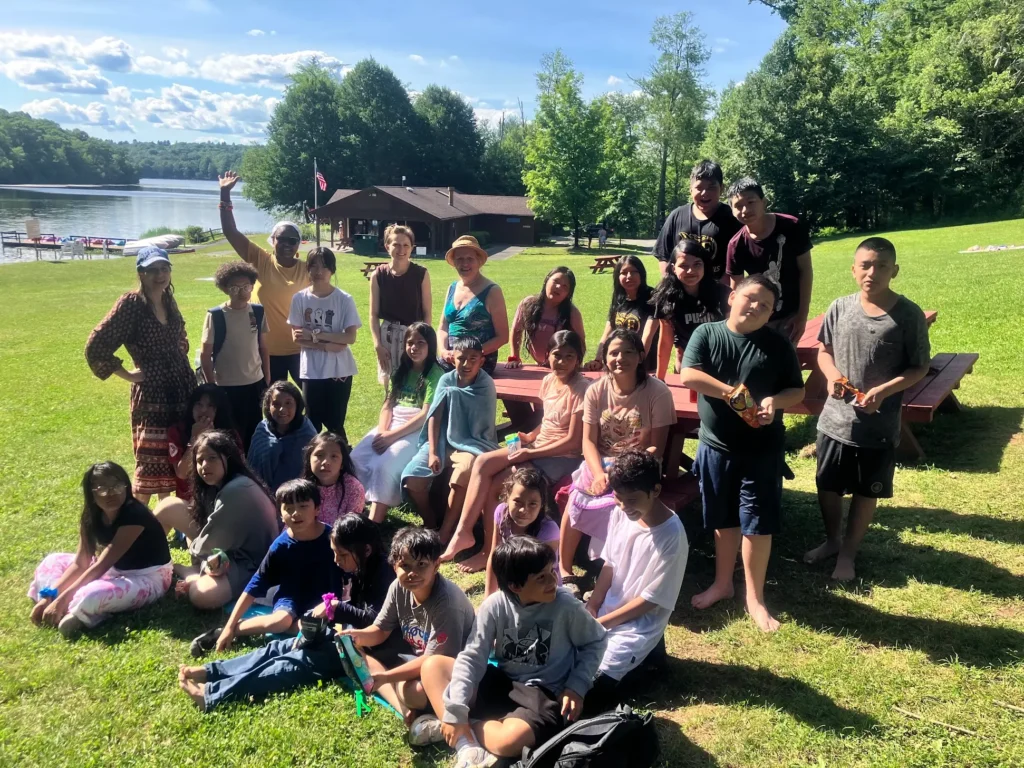
On a mid-July afternoon, the Center buzzes with activity. It is the second week of the two-week Summer Day Program, and controlled chaos fills the building as staff, seminarian fellows, educators and volunteers guide dozens of young people through a range of activities.
Outside, a soccer match is underway. In the basement, children create papel picado—traditional Mexican art involving elaborately cut, colorful paper banners—to decorate the Center. Upstairs, volunteer art teacher Doreen Diorio leads painting workshops while others provide group discussions and a shared meal.
Like the homemade pupusas prepared by longtime volunteer Sandra, the Summer Day Program is a labor of love. The Spark Center, made stronger through a network of partnerships, has found success in collaborating with organizations like the Mid-Hudson Valley Migrant Education Program.
That partnership has become an important bridge for local families, says Alejandra Sanchez-Surman, a tutor at the Migrant Ed. Program. After connecting with RMM through D’Aiuto, she began encouraging her students to attend the Summer Day Program.
A report released by the Citizens’ Committee for Children of New York reveals Sullivan County has the third-highest barriers to wellbeing in the state, driven primarily by educational indicators. The rural landscape and unmistakable poverty of the county leaves 9-to-14-year-olds, the population the Summer Day Program serves, with little opportunities outside of school.
“Summer programs nearby can be up to $800 or $900, and unfortunately, parents cannot afford that,” Sanchez-Surman explains.
The safety and structure provided by the Summer Day Program—which, through funding from generous donors, is entirely free—can be transformative for underserved and vulnerable youth.
In an area marked by its poverty, the Spark Center is finding ways to give young people their own economic opportunity.
On another July afternoon, members of the Youth Economic Group (YEG) gather in the Center’s darkroom to learn the art of screen printing from Juanita Sarmiento, former coordinator of Bags for Justice—YEG’s cooperative business.
Bags for Justice is one of the rare youth co-ops in the rural United States. Operating from the basement of the Spark Center, the group of high school students create t-shirts and tote bags bearing slogans of social justice and generate enough revenue to sustain their enterprise.
Their process is far from simple: members use emulsifying material and printing machines to prepare screens, design artwork, and print their designs onto clothing. As they develop these technical skills, Sarmiento reminds them of the broader significance of their work.
“How many 14-year-olds can say they run and own a unionized business?” she asks.
A union-affiliated business, and the first youth-member organization to join the New York State United Teachers (NYSUT) labor union, the cooperative is a historical feat.
This achievement is particularly striking in the context of Monticello, South Fallsburg and Liberty, where most members live. High school graduation rates in these school districts are 77%, 74% and 69%, respectively. Among YEG members, the graduation rate is 100 percent, with 98 percent of members matriculating into higher education.
The success of YEG, as well as the Summer Day Program, reflects the steady leadership of D’Aiuto and Chief Program Officer Wilmer Jimenez. As the Spark Center continues to receive support from its allies while serving the community, staff seek expansion.
“Right now, it’s a matter of having the training, the people, and the funding,” D’Aiuto explains.
Plans are now underway for a new building on the property to be named in honor of the late Assemblywoman Catherine T. Nolan, who co-led the campaign for the passage of the Farm Laborers Fair Labor Practice Act. The addition will expand programming and community space, while addressing the critical need to house summer interns and seminarian fellows.
According to D’Aiuto, the project is about investing in the young people who already see the Center as their own.
“I’m most excited because our YEG members are excited about it,” she says. “We’ve had discussions at our meetings about the plans for the building on this property, and it’s wonderful to have members…that are the future of this area saying they would love to have a bigger space to expand their business.”
Throughout the training, members continually express enthusiasm to see their business grow. For group member Inmer, YEG’s growth is more than its financial success—it is also deeply personal.
“Being part of YEG, I’ve stepped out of my comfort zone [in a way] that I thought I never would have,” Inmer says. “I have learned about so many social justice issues and, as a son of an immigrant, I have learned that I have a voice.”
Roark Petermann served as a Communications Intern for the summer of 2026.
Rural & Migrant Ministry’s youth arts programming is made possible by the New York State Council on the Arts with the support of the Office of the Governor and the New York State Legislature.