By Roark Petermann
In a moment when political upheaval is burdening the lives of young people, Rural & Migrant Ministry’s newest youth empowerment group is documenting the lived experiences of the communities its members call home.
Youth Lens of Justice (YLJ), based in Albion, NY, is turning to film to address injustice.
Started by former Overnight Leadership Camp participant Y. (whose name is abbreviated for personal safety), YLJ is a direct response to urgent oppression: “It wasn’t until all the horrible things under this new administration started happening,” Y. explains. “That ultimately motivated me to take action.”
Through the art of film and videography, the group advocates for political change.
Their first documentary—an assemblage of archival footage, personal interviews, and community event recordings—explores the culture that farmworking immigrants have brought to Western New York and the United States as a whole. After months of planning, filming, and editing, members have produced a powerful testament to the camaraderie, resilience and anger they feel in the wake of changing federal immigration enforcement policies.
YLJ’s work extends far beyond the screen. Under the guidance of WNY Associate Regional Coordinator and Youth Coordinator Rhiannon Butchko, the group is committed not only to documenting the challenges facing their communities, but also to confronting them with direct action. Members have shared their mission at St. Paul’s Episcopal Church in Rochester, participated in Farmworker Albany Day at the New York State Capitol alongside other RMM youth, joined No Kings demonstrations, and collaborated with the NYSUT teachers’ union.
YLJ joins the Justice Organization of Youth (JOY) as the second youth empowerment group hosted by RMM in Western New York. While the Liturgia Rural Worker Education Center in Lyons, where JOY is based, has long served young people from several counties, YLJ’s Albion location expands RMM’s reach to youth seeking justice and community across a broader region.
“Because we live far away, we [were] unable to be as involved in the events that RMM hosts, and it’s harder to meet and collaborate with other programs more frequently,” Y. says.
Living hours away from RMM’s nearest youth empowerment group, Y. decided to take initiative: “We had to secure a meeting space, recruit members and volunteers, arrange transportation, find a coordinator to help me run the group, and secure funding.”
In and around Albion, long distances and a lack of public transportation creates a challenge for the group as they seek to expand membership. Apart from the weekly two-hour drive Butchko makes to Albion, the struggle for members who must travel great distances for outreach and events can seem insurmountable.
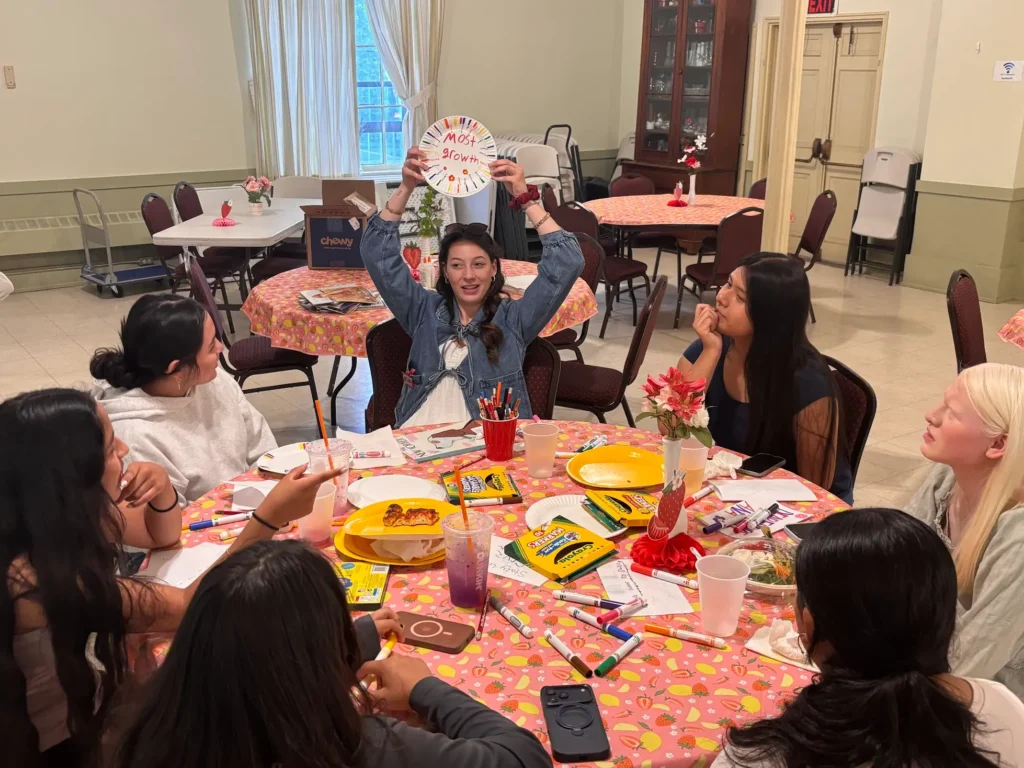
“Right now, transportation is our biggest problem,” a graduating youth member said bluntly at their final meeting of the school year, where YLJ’s first cohort gathered to reflect on the accomplishments and challenges of their inaugural year.
Because the group’s projects emerge through their lived experiences, the meeting offered insight into where their work is headed next. As they discussed ideas for a new documentary, one topic emerged: healthcare.
As the group explains, their community members often fear going to medical facilities, receive inadequate care, experience language and cultural barriers, or lack the insurance or transportation to access healthcare fully.
In Wayne County, where the Liturgia Center is located, “there is one hospital within [a 30- minute] drive and that hospital is currently having mass programs shut down,” said Butchko.
Like their first documentary, which examined the human impact of an oppressive administration, their future plans are ambitious. Working with limited resources, the group has learned to rely on creativity and determination to bring their ideas to life.
For their first project, “We didn’t even have film cameras—we just used our phones,” a group member mentions.
YLJ also had to learn to tell deeply personal stories while protecting the people who shared them: “Some people weren’t comfortable with being on camera or wanting to share their story from fear,” Y. said.
Despite these challenges, YLJ continues to create art that radically humanizes the communities it documents. At the end of the group’s first documentary, a voice narrates over footage of immigrant life and culture in America: “The American Dream is not built through fear. It is built through compassion, dignity, and community.”
In a small town in Western New York, young people are documenting the struggle for justice as they build this dream. For members like Y., this struggle has been a transformative one.
“Starting this group has taught me to fight for what I want, take risks, and never stop standing up for what is right.”
Roark Petermann is a Communications Intern for the Summer of 2026.